MYTILINEOS Holdings Sustainability Report
2014
MYTILINEOS Holdings Sustainability Report
2014
42
43
The complete conversion
of bauxite residues into
usable raw materials
and commercial products
(production of pig iron and
stone wool).
The cost-efficient direct
production of the Al-Si alloy,
which accounts for 30% of the
total aluminium market globally.
The direct utilisation
of renewable energy
sources (solar radiation) in
metallurgical practices.
1
2
3
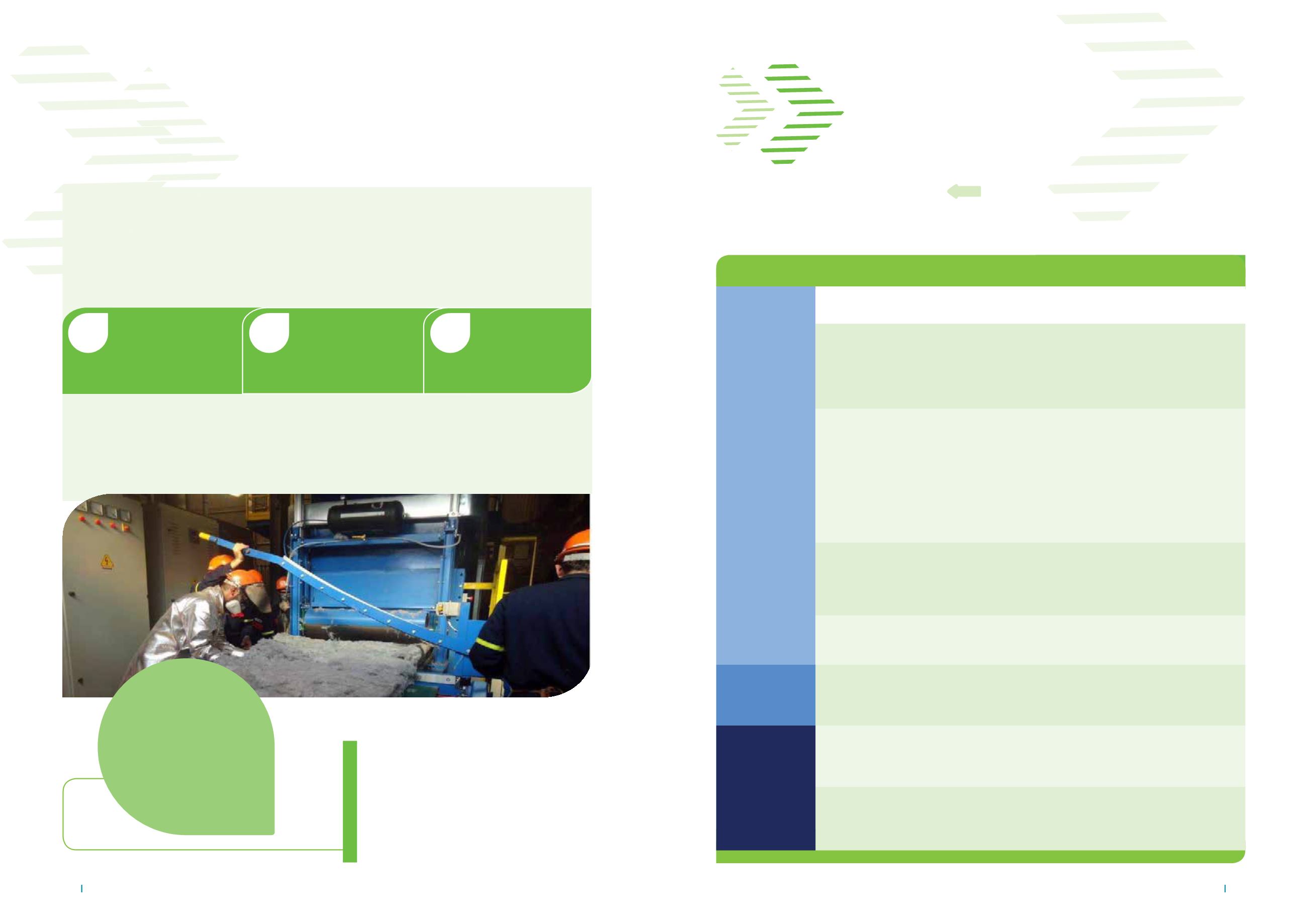
The first one of the above technologies was tested on a pilot basis in the
facilities of ALUMINIUM OF GREECE. The “
ENEXAL
” pilot unit consisted
of a 1 MW electric arc furnace with a capacity of 2000 kg and a stone
wool production machine ("fibre machine") and remained in operation
for 18 months. During this period, dozens of experimental tests were
conducted, seeking to determine the optimal operating conditions for
the furnace, in order to achieve: (a) The optimal production of pig iron,
which corresponds to 30% of the bauxite residue mass; and (b) the
production of fluid slag with specific physical and chemical properties
allowing its use for the production of stone wool.
Results:
The net contribution of
ALUMINIUM OF GREECE to the
implementation of the project stood at
€2.0 million
and concerned equipment, power,
consumables and personnel
expenses.
As regards the management of the liquid waste and water discharges
resulting from the Group's activity, this is done according to the
parameters determined by the environmental terms and regulations
under which the facilities of the Group's subsidiaries have obtained their
environmental licenses.
•
More then 35 tons of bauxite residues were processed.
•
A total of 8 tons of pig iron were produced and tested successfully
in the production of cast-iron spheres in a Serbian steel plant.
•
The stone fibre produced was evaluated in Italy by producers
of related insulation materials and was judged to be more
competitive compared to similar products currently available.
•
The entire quantity of stone wool produced was successfully used
as industrial insulation material in the company's plant.
Management of liquid waste and water discharges of the Group's activity sectors - 2014
Quantity
m
3
/year
Destination
Quantity of water discharges, including treatment method
Metallurgy
& Mining Sector
161,733,577
From the cooling
process of the
Combined Heat
and Power (CHP)
plant
Discharge to the
sea (determined by
legislation)
pH:
8-8.2
Temperature:
22.3
ο
C
541,317
Wastewater, including
rainwater, measured
at the point of exit from
the primary treatment
facilities
Discharge to the
sea (determined by
legislation)
Primary treatment (Settlement of floating particles, filtration of
supernatant fluid, chlorination, discharge).
pH 25
ο
C with temperature compensation:
7.92
Chlorides - mg/l:
240.83
Fluorides - mg/l:
1.23
Biochemical Oxygen Demand (BOD5) - mg/l:
7.93
Chemical Oxygen Demand (COD) - mg/l:
8.16
Total Solids (103-105
ο
C) - mg/l:
821.67
Total Suspended Solids (103-105
ο
C) - mg/l:
8.92
Fluorides - mg/l:
0.01
24,912
Wastewater from the
mining process
Subsoil
No particular processing. This waste is water (from licensed drills or
water collected in underground mining sites) used in the mining process,
which with the addition of inert bauxite or limestone dust (depending
on the particular mining activity), becomes a liquid mix that ends in the
aquifer.
2,500
Wastewater from
mining site workshops
Watering of
rehabilitated areas.
Cleaning of liquid waste from sites using a system of filters (sand - active
carbon). The water obtained from this process is suitable for irrigation
(site landscape rehabilitation) or reuse in the production process.
Energy
Sector
12,183
Industrial service
water in the electricity
production process
Disposal to a Motor
Oil liquid waste
treatment plant
The amount of the industrial service water intended for disposal to Motor
Oil undergoes treatment for ph regulation (must be from 6.5 to 9), as well
as for temperature regulation (must be <65
ο
C.).
EPC Projects
Sector
1,600
Water from Hydraulic
Tests in Construction
Sites
Treatment in the
Project's Biological
Treatment Facilities
Rainwater collection network & disposal for use in irrigation
25,000
Water from
chemical cleaning in
Construction Sites
Temporary storage
in a site tank for
thermal load
balancing
External licensed Biological Treatment Facilities
Investing in research and development of new technologies that can
substantially contribute to the efficient management of waste is part of the
Group’s environmental policy. In this respect, 2014 saw the completion
of the participation of the MYTILINEOS Group subsidiary ALUMINIUM
OF GREECE, in the "
ENEXAL
" four-year research project (June 2010 -
November 2014), whose objective was to develop cost-efficient "green"
technologies in the aluminium industry. The project coordinator was
ALUMINIUM OF GREECE, while the other nine partners included major
European Universities such as the National Technical University of
Athens (NTUA), the Aachen Technical University (RWTH) and the Zurich
Polytechnic (ETH). The three innovative technologies examined in the
framework of the project concerned:
"ENEXAL” EUROPEAN RESEARCH PROJECT
Management of liquid waste and water discharges
(G4-EN22)


