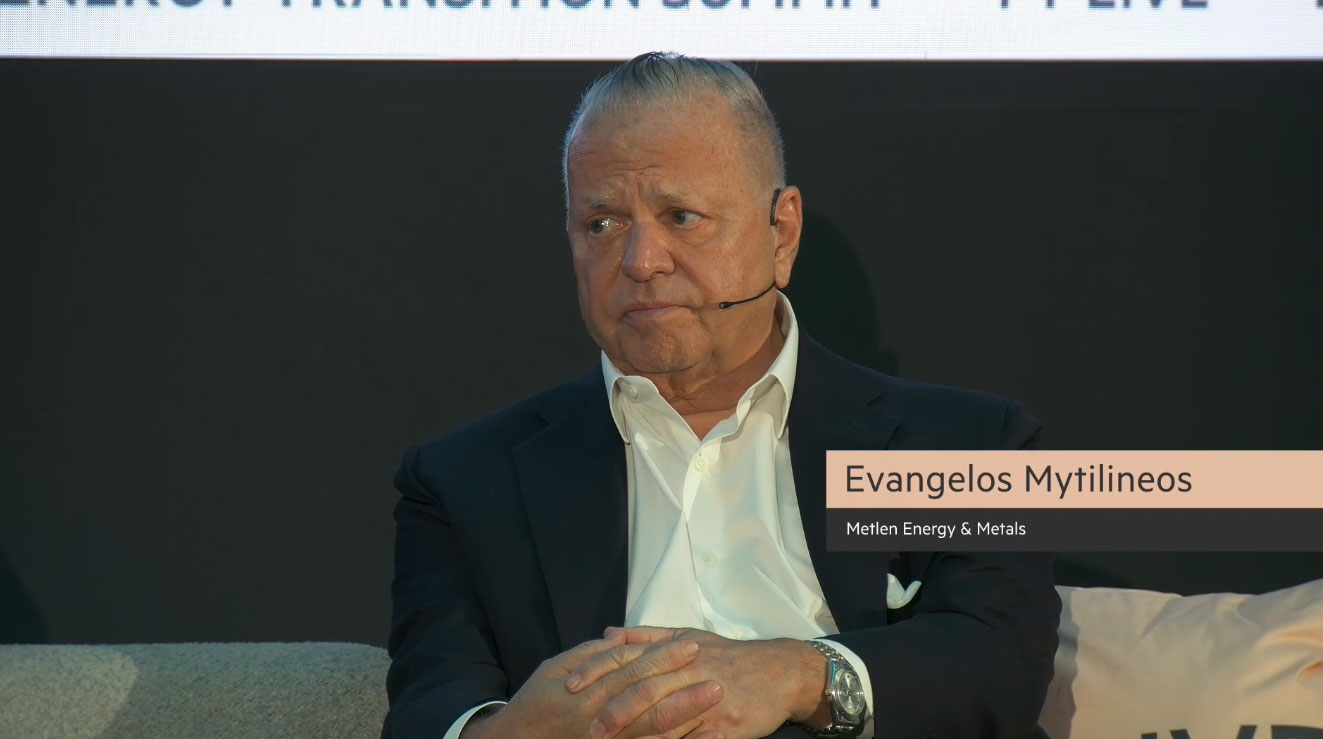
At the “Energy Transition Summit: East Med & Southeast Europe” hosted by the Financial Times and Kathimerini, Evangelos Mytilineos, Executive Chairman of METLEN Energy & Metals, joined a discussion with Ben Hall, Europe Editor of the Financial Times. He outlined a landscape marked by heightened energy and geopolitical uncertainty, particularly in light of developments in the Strait of Hormuz and their impact on global markets.
Addressing the commodities market, he noted that aluminium prices are rising significantly, driven by the concentration of global production in the Gulf region. At the same time, natural gas—described as the most critical input for the company’s industrial operations—has increased by 40–50%, materially impacting production costs. He added, however, that the company has already implemented hedging strategies covering 2026 and 2027.
Mr. Mytilineos also highlighted the risk of Europe replacing one dependency with another—shifting from Russian pipeline gas to liquefied natural gas (LNG), predominantly sourced from the United States. He noted that LNG now accounts for approximately 80% of the company’s imports via Revithoussa. He further cautioned that any use of energy as a geopolitical tool by the U.S. would have far-reaching implications for transatlantic relations.
In this context, he underscored the pressing issue of European industrial competitiveness. For industries competing globally at electricity price levels around €30/MWh, current energy costs render long-term viability increasingly challenging. As he pointed out, European industry has been raising these concerns with Brussels for years, with limited tangible outcomes.
He also criticized the EU’s broader strategic approach to heavy industry, noting that for years the prevailing view suggested that Europe no longer required energy-intensive industrial activity.
Turning to the broader European outlook, he warned that relatively low natural gas storage levels compared to previous years are adding pressure, while a potential shift in demand toward Asia could drive prices even higher. Market sentiment, he added, currently assumes that tensions in the Gulf will be short-lived.
On the energy transition, he emphasized that progress is not linear but occurs in “waves,” with current priorities shifting from decarbonization and climate objectives toward energy security. Countries with limited access to affordable energy are accelerating investments in renewables and infrastructure to enhance autonomy, while Europe is reassessing its strategy amid geopolitical instability.
He placed particular emphasis on energy storage, stressing that the next phase of renewable energy growth will be driven less by climate considerations and more by energy security imperatives. However, he noted that the key challenge remains storage—especially meeting nighttime demand. Without cost-effective battery solutions offering 6–10 hours of duration, full decoupling from fossil fuels remains unattainable. “The question the energy community must answer is what we do during the night,” he remarked.
In this context, he referenced METLEN’s new large-scale energy storage project, with a capacity of 330 MW, currently under construction and expected to be delivered in the near term. Even so, he observed that one of the largest battery systems in Europe today can provide only around two hours of domestic coverage.
On PPC’s share capital increase, Mr. Mytilineos noted that market signals so far are positive, with PPC having an extensive growth plan, particularly outside Greece—a development evolution expected to strengthen the overall momentum of the market.
Finally, he noted that the linkage between electricity prices and natural gas continues to pose a significant competitiveness challenge for industry, as average power prices remain structurally elevated.