The milestones of his four-year tenure at the leading European association
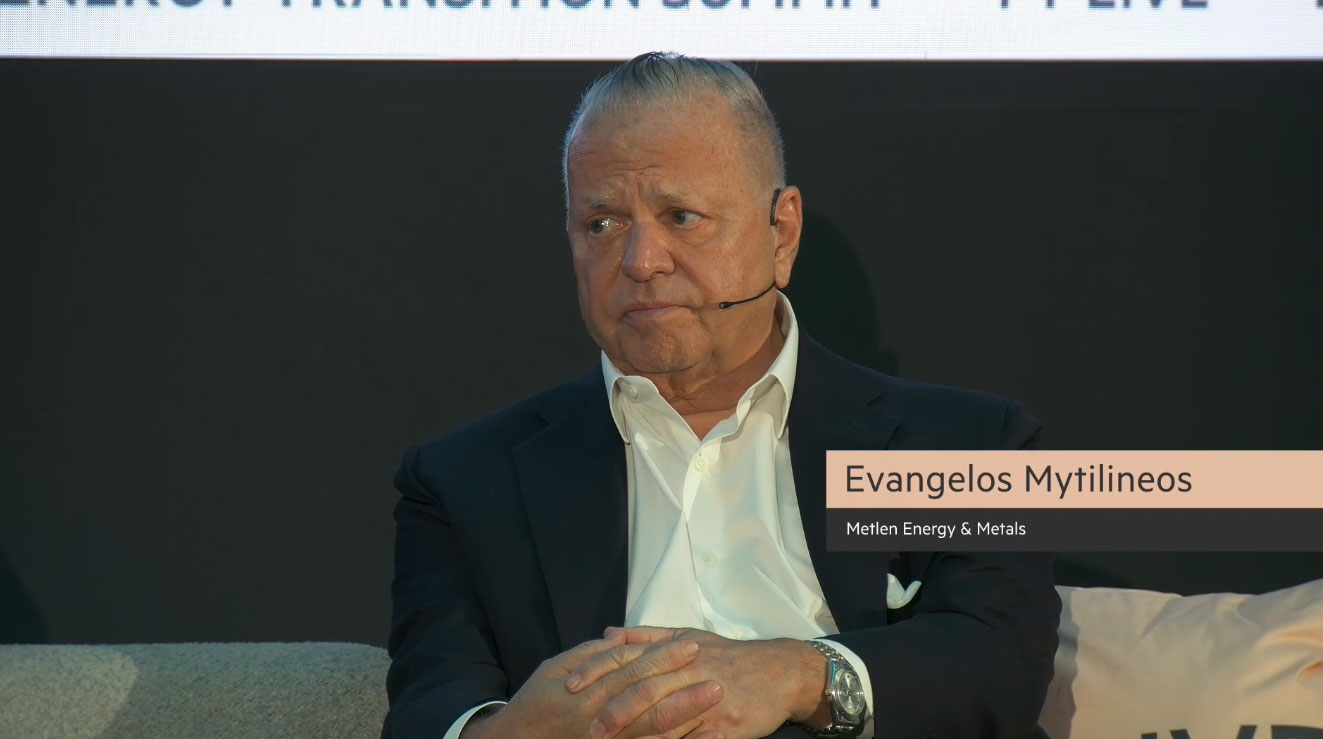
At a time of heightened strategic importance for Europe’s metals industry, European Metals held its General Assembly on Wednesday, 1 July 2026, at METLEN’s headquarters in Maroussi. As part of the proceedings, the four-year tenure of Evangelos Mytilineos as President of the pan-European association of non-ferrous metals industries officially came to an end.
The leadership handover at European Metals was attended by Stellina Siarapi, Secretary General for Private Investments at the Ministry of Development; Aleksandra Kordecka, member of the office of European Commission Executive Vice-President for Prosperity and Industrial Strategy, Stéphane Séjourné; as well as senior executives from European Metals member companies, reaffirming the organisation’s institutional role in strengthening Europe’s metals industry.
During Evangelos Mytilineos’ two terms as President of European Metals, there was a multifaceted shift both in the European public debate and in the European Union’s own approach to industrial policy: critical metals, circular metallurgy and security of supply are now at the heart of discussions on Europe’s strategic autonomy.
Announcing the election of the new President, Evangelos Mytilineos, Executive Chairman of METLEN, said: “Over the past four years it has been my great privilege and honour to lead the European non-ferrous metals industry in its work to improve the policy situation for our sector. We have seen great strides taken at the EU level with the delivery of the Critical Raw Materials Act, the Steel and Metals Action Plan, the Clean Industrial Deal and more recently the Industrial Accelerator Act. But there is still a lot of work to do on energy costs, on the Emissions Trading System, the CBAM and importantly on circularity in the metals sector including addressing the record volumes of aluminium and copper scrap leaking from the EU to our global competitors.’ He added: ‘This is an important moment for Inge Hofkens to lead the association into the next phase of boosting our industry in the corridors of power in Europe.”
Over this four-year period, and especially during the past two years, European Metals played a decisive role in ensuring that metals were recognised as a key pillar of Europe’s strategy for the future and that industrial strength was acknowledged as a strategic advantage for Europe. Challenges such as high industrial energy costs, aluminium scrap exports outside Europe and excessive bureaucracy are still here, and some of them have become even more complex.
Minister of Development Mr Takis Theodorikakos highlighted the “substantial contribution” of Mr Mytilineos and European Metals “in ensuring that the voice of real production is heard more clearly in European decision-making centres”, at a time when Europe’s industrial strategy is being redefined. “Greece cannot claim a strong role in Europe unless it invests in its own industrial strength. This is also the key message we want to send today as Greece: we are participating in the new European industrial policy not only as a country with a significant geostrategic position, but as a country that strengthens industry and innovation, supports strategic investments and can help meet Europe’s critical needs. This is the core of the strategy we serve at the Ministry of Development for the productive transformation of the Greek economy,” the Minister added.
Mrs Siarapi said: “We need, perhaps more than ever, a Europe that innovates, produces and exports on competitive terms, if it is to stand with confidence against fierce international competition. And this is directly related to our discussion today. Because metals, and critical raw materials in particular, are not simply an important sector of the economy. They are the foundation on which other industrial sectors also depend. In this field, Greece has the potential to play an important role, through projects that are part of European value chains and strengthen European autonomy. METLEN today is a strong example of this potential: a Greek industry with a strong international presence, a vertically integrated production base, an export orientation and expertise in sectors that are critical for Europe’s future.”
Speaking on behalf of the Commission Executive Vice-President Séjourné, Ms Kordecka said: “We are very much aware of the immense pressure currently faced by European energy-intensive industries: production has declined, imports have increased, energy costs remain structurally high and global overcapacity is depressing prices. And while all this is happening, we are asking European industry to decarbonise. So the challenge is huge. We know that. We also know that we can help change the tide if we work hand in hand, if we do it in a smart way, with the right conditions.”
She also noted that “today Greece has strategic raw materials, aluminium production, energy infrastructure. Greece has ports, skilled workers and renewable potential. And these assets are part and parcel of the bigger story. They are contributing to Europe’s industrial sovereignty. A concrete example is the integrated CRMA Strategic Project promoted by METLEN Energy & Metals and European Bauxites. Together, they aim to contribute to Europe’s supply of bauxite, alumina, aluminium and gallium. This is exactly the type of project Europe needs: a holistic project that connects extraction, processing, critical raw materials, strategic metals and industrial capacity in Europe.”
Inge Hofkens, who succeeds Evangelos Mytilineos, is Chief Operations Officer specialising in metals recycling at the German company Aurubis.
The new President said: “I am grateful to the members of European Metals for placing their trust in me to lead the association in this vibrant moment. We have crucial policies for our sector coming up in the next few months, not least the Circular Economy Act, which must deliver on multiple opportunities for metal recycling, processing and refining in Europe in answer to the strongly growing metal demand and desired raw material resilience. This is a huge potential source for critical raw materials that today are left untapped. As demand for critical raw materials grows and Europe's need for resilience becomes more urgent, unless we strengthen Europe's processing and smelting capacities, critical raw materials will continue to flow to competing economies, where the economic value, strategic resilience and industrial competitiveness they generate will increasingly accrue. We need to take swift action to address the loss of scrap copper and other strategic metals from the EU. It will be my priority to make sure that our European metals industry has the best possible policy framework to thrive in Europe.”
The next chapter for European Metals requires a move from strategic declarations to implementable policies, through a comprehensive and coherent framework for a circular metals economy.
With the election of Inge Hofkens as President, European Metals sends a clear message: European autonomy, and especially access to critical raw materials, is a strategic priority. To achieve this, the policies currently being shaped must address existing gaps and asymmetries, strengthening Europe in terms of investment, strategy and growth.